Çiçeksepeti Brand Complaints: What to Do When There Is No Portal (2026)
Muhammet Çay · 18 September 2026 · 13 min read
Short answer: Çiçeksepeti does not publish a separate portal for brand owners, so there is no self-service screen to file an infringement notice through. That does not leave you without a route. Turkish e-commerce legislation recognises notary notice and registered electronic mail, known as KEP, as filing channels, and a filing made this way produces exactly the same legal effect as one made through a marketplace panel: on a compliant complaint the marketplace must remove the listing without delay and within no more than 48 hours. Çiçeksepeti's KEP address is ciceksepeti@hs01.kep.tr and its MERSIS number is 0253075950300010. The five mandatory elements of the complaint are the same as everywhere else, and an incomplete filing is not processed at all.
No portal is not the same as no route
Çiçeksepeti does not publish a portal dedicated to brand owners in the way Amazon publishes a brand registry or n11 publishes a brand protection centre. Searching for one and finding nothing is a common first step, and it stops many brands there. The absence of a dashboard does not mean the platform ignores intellectual property rights. It means the intake mechanism lives outside the seller interface. Brands that treat the missing portal as a dead end leave listings unchallenged while the law still provides a path.
The route exists in legislation rather than on the platform. Turkish e-commerce rules recognise notary notice and registered electronic mail as filing channels, and a filing made through either produces the same legal effect as a panel submission. A brand owner does not need a login or a case ID generated by Çiçeksepeti to start the process. The legal effect attaches once the notice reaches the addressee through a recognised channel. Platform portals are operational conveniences; they are not the only valid trigger for a takedown obligation.
Registered electronic mail is known in Turkey by its initials, KEP. It is a legally recognised email system that produces a delivery record, which is why it is preferred over ordinary email for filings that must be provable. Ordinary email carries no statutory proof of receipt. KEP generates a timestamped receipt that courts and the platform accept as evidence of service. Using KEP removes the dispute over whether the notice arrived. The system is operated by authorised providers and is available to foreign entities.
Çiçeksepeti's KEP address is ciceksepeti@hs01.kep.tr, published on its own contact page alongside its legal entity name, postal address and MERSIS number 0253075950300010. The address is public and does not require a partnership agreement to use. A brand owner can send the notice directly from any KEP account. The MERSIS number identifies the legal entity that must receive the notice. Sending to the published KEP address satisfies the formal notification requirement under the e-commerce regulation.
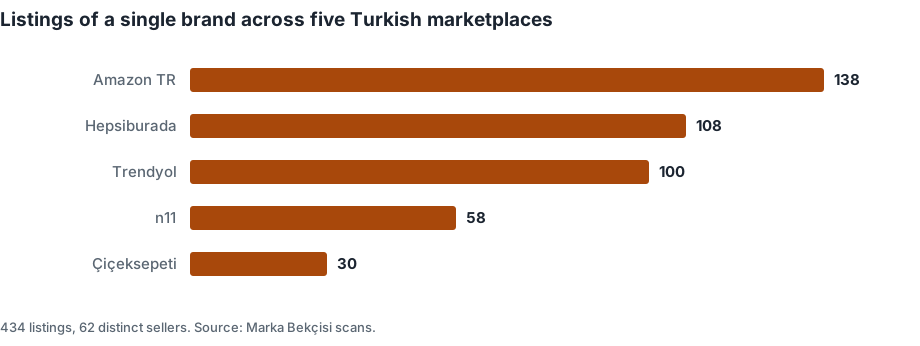
In our own scan of a single brand across five Turkish marketplaces, Çiçeksepeti carried 30 listings against 143 on Amazon.com.tr and 108 on Hepsiburada. It is the smallest of the five and it is rarely empty, which is precisely why the missing portal matters. Low volume does not mean low risk. Unauthorised listings on a smaller platform can signal distribution leaks that feed larger channels. Ignoring the platform because it lacks a portal leaves a gap in the monitoring chain. The legislative route closes that gap without waiting for a platform feature.
More on this: the verified IP contact channels and KEP addresses of Turkish marketplaces.
The five elements that make a filing valid
Article 12 of the regulation sets out five mandatory elements for a complaint, and an incomplete filing is not processed. This applies to every Turkish marketplace, whatever channel the filing arrives through. A brand owner who submits a notice missing even one element receives no acknowledgement and no timeline. The marketplace treats the submission as if it never arrived. Many teams assume a portal confirmation email means the case is live, but the regulation requires substantive completeness before any clock starts. Checking the five elements against the draft before sending prevents silent rejection.
Because an incomplete filing is not processed, the 48-hour removal period never starts. When nothing happens after a filing, the first thing to check is completeness rather than elapsed time. Teams often count hours from the send date and escalate to support when the listing remains active. The regulation makes clear that the deadline is conditional on a valid filing, so the clock has not begun. A completeness audit resolves the stall faster than a follow-up ticket. Treat silence as a signal to verify the package, not as a delay to chase.
| Element | What it is | Common failure |
|---|---|---|
| Trademark registration certificate | Proof of the right in Turkey | A foreign registration not extended to Turkey |
| Identity and address of the rights holder | Who is filing | Filed by an agent without proof of authority |
| Grounds and evidence | Why this listing infringes | A general statement with no listing-level evidence |
| Internet address of the product | The specific listing URL | A search page or a store link instead of the listing |
| Declaration of liability | Accepting liability if the claim is untrue | The element most often left out entirely |
The declaration accepting liability if the claim proves untrue is the element most often omitted, and it is not optional. The regulation places the risk on whoever makes the assertion, because the marketplace itself does not decide the merits. Foreign brand owners sometimes treat this as a formality and leave it unsigned or use a template that omits the liability wording. Without that declaration the entire package is incomplete and the marketplace will not act. Include a signed statement in Turkish or with a certified translation that expressly accepts liability for a false claim. Attach it to the same email or upload as the other documents.
The internet address must identify the specific listing. A link to a search results page or to a seller's storefront does not identify a product, and the filing fails on that element. Copying the URL from a browser search bar often captures a session or filter rather than the single product page. The marketplace needs a direct, permanent link to the exact offer page so the content team can locate and review it. Open the listing in an incognito window, copy the address bar, and paste that single URL into the filing. Do not shorten it, do not redirect it, and do not substitute a storefront overview.
Where a Turkish agent or law firm files on behalf of a foreign brand owner, proof of authority belongs in the same package as everything else. A power of attorney or authorisation letter that sits in a separate email or a different folder does not satisfy the requirement. The reviewer must see the mandate alongside the complaint, the declaration, the trademark certificate and the listing link in one submission. Prepare a single PDF bundle or a single email thread that contains every document. Missing authority proof is a common reason a filing from outside Turkey stalls at the first check.
| Element | Practical check |
|---|---|
| Complete set of five elements | Verify every item before sending; an incomplete filing is not processed |
| 48-hour period | Starts only after a valid filing; silence means check completeness first |
| Liability declaration | Signed, in Turkish or certified translation, accepts risk of false claim |
| Listing URL | Direct link to the single product page; not a search or storefront URL |
| Agent authority | Power of attorney or authorisation letter included in the same package |
More on this: the 48-hour takedown rule and its five mandatory elements.
Filing by notary or by KEP
A notary notice is prepared and served through a Turkish notary and produces a formal service record. It is the slower and more expensive of the two channels and it is the one foreign rights holders most often use, because it does not require a Turkish electronic mail account. The notary handles the physical delivery and records the exact date and time of service in an official protocol. That protocol becomes the evidence you present if the marketplace or a court later asks for proof of notice. Foreign rights holders choose this route when they do not yet have a local representative with a KEP address.
A KEP message is faster and cheaper and produces its own delivery record. Turkish entities generally hold a KEP account; foreign rights holders usually file through a Turkish representative rather than directly. The electronic system timestamps the dispatch and the receipt automatically, removing the need to schedule a notary appointment. Your representative sends the notice from their registered KEP address to the platform's registered KEP address. The delivery receipt issued by the KEP provider serves as the formal proof of service.
Whichever channel you use, the content is identical: the five mandatory elements, with the listing addresses named one by one. The channel changes the delivery record, not the substance. You do not draft a different letter for a notary than you would for a KEP transmission. The same identification of the right, the same listing URLs, and the same demand for removal appear in both. Only the method of service and the resulting evidence differ.
Keep a timestamped screenshot of every listing you name. If the listing is edited after your filing, that screenshot is the only record of what it said when you filed. Sellers can change a product title, description, or image within minutes of receiving a notice. Without a screenshot taken at the moment of filing, you cannot prove which version of the listing triggered your complaint. Capture the full browser window showing the URL, the date stamp, and the complete listing content.
Confirm the KEP address on Çiçeksepeti's own contact page at the time of filing rather than from a third-party article. Contact points change, and a filing sent to a stale address is a filing that did not happen. A KEP message delivered to an outdated address produces a delivery receipt, but the platform never receives the notice. Check the official contact or legal page immediately before you send the message. Record the address you used and the date you verified it alongside your filing records.
More on this: how the notary and KEP route works at Hepsiburada.
What happens after the filing
On a compliant complaint the marketplace must remove the listing without delay and within no more than 48 hours. Removal at this stage does not mean infringement has been established; the platform is answering a procedurally valid filing. The takedown is a procedural response, not a judgment on the merits of the intellectual property right. Brand owners often mistake the removal for a confirmation that the product is counterfeit. In reality, the listing is offline only because the notice met the formal requirements. The seller still has a statutory path to restore the listing.
Article 13 gives the seller a right of objection, supported by an invoice, supply chain documents tracing back to the rights holder, and its own declaration of liability. The seller can submit these documents to challenge the takedown. A valid invoice showing purchase from an authorised channel is often enough to trigger the reinstatement mechanism. Many brand owners assume the platform will evaluate the authenticity of the goods itself. The platform does not perform a forensic product inspection; it reviews the paperwork the seller provides.
Under Article 14 a compliant objection puts the listing back within 24 hours, no second complaint on the same product and the same claim is processed without new documents, and the marketplace's review is limited to the documents submitted. Once the seller files a complete objection, the clock starts for reinstatement. You cannot file a second complaint on the identical product and claim without supplying new documents. The marketplace’s review is confined to the record the seller created. This procedural lock-in means your first filing must be targeted at listings you can prove are counterfeit.
This is why a filing against genuine goods usually fails. Under Article 152 of Law No. 6769 the resale of goods put on the market by the right holder or with consent cannot be blocked on trademark grounds alone. Exhaustion of rights applies once genuine goods enter the market with your consent. A trademark complaint cannot be used to control distribution or pricing of authentic products. Brand owners frequently waste their single complaint opportunity on parallel imports. The legal framework treats those listings as lawful resale.
Decide before filing whether the listing is counterfeit or grey market. Spending your one complaint on a grey-market listing weakens your position when you later find a genuine counterfeit. The procedural rules give you one effective shot per product and claim. If you use it on a listing that the seller can defend with a valid invoice, the listing returns and you lose the ability to challenge it again on the same grounds. Reserve the complaint for listings where you have evidence the goods are not genuine.
More on this: how to find every seller of your brand in Turkey.
Building the list before you file
None of the above tells you which listings to name. That is the part every channel leaves to the rights holder, and it is the part that takes the time. You must identify the specific URLs or listing IDs yourself before you open the complaint form. The platform will not suggest targets or pre-fill a list based on your trademark registration. A filing that arrives without concrete listing references will be rejected or delayed until you supply them. Treat list assembly as a separate workstream that precedes any legal or compliance step.
Çiçeksepeti does not expose seller identity in its search results the way Hepsiburada does, so seller-level analysis there needs the listing pages themselves. You cannot rely on a search-results grid to reveal the merchant behind each offer. Opening each product page is the only way to capture the seller name, storefront link and fulfilment details. Skipping this step leaves you with a list of products but no accountable party to name in the complaint. The extra click per listing is the operational cost of accuracy on this channel.
Scanning five Turkish marketplaces by hand takes days, and a list assembled once goes stale within weeks as sellers appear and disappear. Producing and refreshing that list is the work we do. A snapshot captured on Monday will miss the ten new sellers who launch on Wednesday. Relying on a static spreadsheet means you file against ghosts while live infringers remain untouched. Continuous monitoring replaces the one-off audit with a living dataset that matches the marketplace’s actual churn rate.
Prioritise before filing. The strongest filings name the listings with the clearest evidence, not the largest number of listings. A complaint that cites fifty weak matches dilutes the reviewer’s attention and increases the chance of a blanket rejection. Focus first on listings where the trademark appears in the title, main image or brand field without authorisation. Add secondary targets only after the primary set is documented and ready. Quality of evidence drives the outcome more than volume of URLs.
If your goal is to control distribution rather than to remove counterfeits, the complaint route is the wrong tool entirely and an authorised-dealer certificate is the right one. Marketplaces treat unauthorised-but-genuine sales as a distribution issue, not an intellectual-property violation. Filing an IP complaint against a legitimate reseller will fail because the rights in the physical goods are exhausted. The authorised-dealer certificate, or a marketplace whitelist built from it, is the mechanism that lets you decide who may sell. Use the complaint channel only for counterfeit or trademark-misuse cases.
If you would rather not count these by hand, we run the scan across all five marketplaces and send the report free: free scan.
Frequently asked questions
Does Çiçeksepeti have a brand owner portal?
Çiçeksepeti does not publish a brand owner portal. Filings must use the channels recognised by Turkish e-commerce legislation: notary notice or registered electronic mail. Çiçeksepeti's KEP address is ciceksepeti@hs01.kep.tr, published on its own contact page together with its MERSIS number 0253075950300010.
Is a KEP filing as strong as a marketplace panel filing?
A KEP filing carries the same legal effect as a marketplace panel filing. The regulation attaches the effect to a compliant complaint, not to the channel. On a compliant complaint the marketplace must remove the listing without delay and within no more than 48 hours, whether it arrived by panel, notary or KEP.
What makes a filing incomplete?
A filing is incomplete if any of the five mandatory elements is missing: the trademark registration certificate, the identity and address of the rights holder, the grounds and evidence, the internet address of the product, and the declaration accepting liability if the claim proves untrue. The declaration is the most commonly omitted element, and an incomplete filing is not processed at all.
Can a foreign brand owner file directly?
Foreign rights holders usually cannot obtain a Turkish KEP account and file through a Turkish representative or a notary instead. What matters substantively is a trademark right that exists in Turkey; confirm both points with Turkish counsel before planning an enforcement round.
The seller objected and the listing came back. What now?
Under Article 14 a compliant objection puts the listing back within 24 hours, and no second complaint on the same product and the same claim is processed without new documents. If the goods are genuine, the answer is distribution control rather than another filing; if they are counterfeit, new evidence such as a sample examination is what reopens the route.
Sources
- Çiçeksepeti — Contact and corporate details (Turkish) — Legal entity name, postal address, MERSIS number 0253075950300010 and KEP address ciceksepeti@hs01.kep.tr
- Çiçeksepeti — Membership Agreement (Turkish) — Terms governing listings and the platform's intermediary role
- Çiçeksepeti Akademi — Frequently Asked Questions (Turkish) — Seller-side support content; there is no separate brand-owner portal published here
- Regulation on Electronic Commerce Intermediary Service Providers and Electronic Commerce Service Providers — Official Gazette 29 December 2022, no. 32058 — complaint channels and five mandatory elements art. 12, objection art. 13, reinstatement art. 14
- Law No. 6563 on the Regulation of Electronic Commerce (Turkish) — Framework law for electronic commerce in Turkey
- Industrial Property Law No. 6769 — full text (PDF, Turkish) — Article 152, exhaustion of rights: resale of genuine goods put on the market with consent cannot be blocked on trademark grounds
Related guides
n11 Brand Protection Centre: Membership and Filing an Infringement Notice (2026)
n11 does not accept direct IP complaints. You join the Brand Protection Centre first: the documents, the address, the KEP alternative and the filing flow.
6 September 2026 · 9 minHepsiburada IP Complaints for Brand Owners: Notary or KEP Only, 48 Hours Down, 24 Hours Back (2026)
How a rights holder files an intellectual-property complaint on Hepsiburada: why the seller portal is closed to brand owners, the KEP address dmarket@hs02.kep.tr, the mandatory elements, the sample declaration templates, the 48-hour removal, the 24-hour republication, and the one-shot rule.
6 September 2026 · 5 minWhere to Send an IP Complaint on Turkish Marketplaces: Channels and KEP Addresses (2026)
The rights-holder channel and verified KEP address for each of the five Turkish marketplaces: Trendyol, Hepsiburada, n11, Çiçeksepeti and Amazon.